
How to Fly Fish: A Complete Beginner’s Guide
By Bobby Harris — Navy FMF Corpsman (2002–2010), founder of First Rise Outfitters
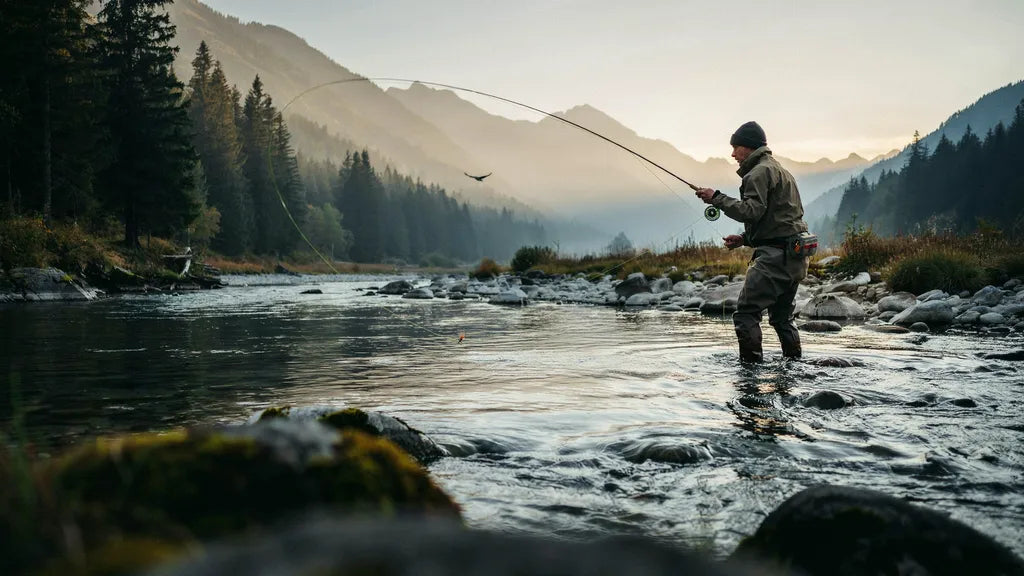
Fly fishing looks intimidating from the outside. The whipping line, the tiny hand-tied flies, the waders, the vocabulary: leader, tippet, mending, matching the hatch. It reads like a private club with its own language. It isn't. Strip away the jargon and fly fishing is one idea: instead of casting a heavy lure and letting it pull light line behind it, you cast a heavy line and let it carry a nearly weightless fly. Learn that one mechanical difference and everything else is detail you can pick up on the water.
This guide walks you from zero to your first fish on the fly — the gear, the setup, the cast, the knots, how to read a river, and how to actually hook and land a trout. Reference links to trusted sources are collected at the end so you can go deeper on any section.
What Is Fly Fishing?
Fly fishing is a method of fishing where the weight of the line, not the lure, carries a nearly weightless artificial fly to the fish. You cast a weighted line; the fly rides along at the end of a clear, tapered leader and lands like a real insect. That single mechanical difference drives everything else in the sport — the gear, the cast, the drift.
To start, you need five things: a 9-foot 5-weight rod, a matching reel with weight-forward floating line, a 7.5–9-foot tapered leader with 5X tippet, a handful of proven flies (Adams, Elk Hair Caddis, Pheasant Tail, Woolly Bugger), and nippers. A balanced starter outfit runs a few hundred dollars, and waders are optional — the bank works fine. Most beginners can learn the basic overhead cast in one afternoon on a lawn and catch their first trout with a nymph drifted through a current seam.
Why Is Fly Fishing Different from Regular Fishing?
In spin fishing, the lure's weight loads the rod and pulls line off the reel. In fly fishing, the fly weighs almost nothing; you can't cast it on its own. So the line is weighted, and the rod acts like a spring, storing energy on the backcast and releasing it on the forward stroke to shoot that line toward the fish. The fly just rides along at the end.
That's why fly casting is a skill instead of a reflex. You're not throwing a weight; you're timing the load and unload of a rod. Once that clicks, the rest of the sport opens up.
What Gear Do You Need to Start Fly Fishing?
You can spend a fortune on fly gear. You don't need to. A capable starter setup runs a few hundred dollars, and most brands sell "outfits" — rod, reel, and line already balanced and ready to fish. Here's what the kit breaks down to, and both Wired2Fish and L.L.Bean publish good beginner breakdowns if you want a second opinion before you buy.
The rod. Fly rods are rated by "weight" (written as 3wt, 5wt, 8wt, etc.), which refers to the line weight the rod is built to throw, not the rod's physical heft. For an all-around freshwater beginner, a 9-foot, 5-weight rod is the near-universal recommendation. It's light enough for small trout streams and heavy enough to handle wind, bass, and bigger water. Go lighter (3–4 wt) for tiny creeks and panfish; heavier (7–8 wt) for bass, pike, or saltwater.
The reel. For most trout fishing, the reel is mainly line storage — you fight small fish "by hand," stripping line in with your fingers. Match the reel size to the rod weight and don't overthink it. Drag matters more once you're chasing fish that make long runs.
The line. This is where the magic (and the weight) lives. Buy a weight-forward floating line matched to your rod weight (a 5wt line for a 5wt rod). Weight-forward means the front section is thicker, making it easier for beginners to cast. Floating line covers the vast majority of trout situations.
Leader and tippet. You don't tie the fly straight to that thick, colored line; a fish would see it. Instead, you connect a leader, a clear, tapered length of monofilament (usually 7.5 to 9 feet) that goes from thick at the line end to thin at the fly end. As you change flies and shorten the leader, you extend it with tippet, a spool of clear, level line in the same diameter. Tippet is sized by an "X" system: a higher number = a thinner line. 5X is a good everyday trout size; 6X for spooky fish and tiny flies, 3X–4X for bigger flies and bass.
Flies. A small starter selection covers most days: a couple of dry flies (Adams, Elk Hair Caddis), a couple of nymphs (Pheasant Tail, Hare's Ear, a beadhead or two), and a streamer (Woolly Bugger) will catch fish almost anywhere trout swim.
The extras. Nippers (or nail clippers) to cut line, forceps to unhook fish, floatant for dry flies, split shot for weight, a small fly box, polarized sunglasses (they cut glare so you can see fish and structure and they protect your eyes from a wayward hook), and a net that's easy on the fish. Waders are optional to start; plenty of people begin by fishing from the bank in shorts and old sneakers.
How Does a Fly Fishing Rig Go Together?
From reel to fish, the connection order is: backing → fly line → leader → tippet → fly. Backing is thin line that fills the reel and gives you reserve if a big fish runs. Most starter outfits arrive with backing and line already installed, so day one you're mostly dealing with the business end: attaching a leader to the fly line (many lines and leaders now have pre-made loops that connect loop-to-loop in seconds), adding tippet, and tying on the fly.
How Do You Cast a Fly Rod?
Casting is the one part you can't buy your way past, but the basic overhead cast is learnable in an afternoon of practice on a lawn. Orvis's free video lessons are the gold standard for learning it visually, and their written breakdown of the basic overhead cast covers the fundamentals below.
The core motion. Think of your forearm as the hand of a clock. Start with line out in front of you on the ground. Accelerate the rod smoothly back to roughly the 1 o'clock position (backcast), then pause to let the line straighten out behind you, then accelerate forward to about 10 o'clock and stop crisply. The line follows the rod tip, so a straight-line stroke throws a tight, efficient loop.
The pause is everything. The single most common beginner mistake is rushing. On the backcast, the line has to fully extend behind you before you start forward — if you come forward too early, you crack the line like a whip, and the fly snaps off. Watch your backcast at first. Feel the slight tug when the line loads the rod, then go.
Stop the rod. Power comes from a sharp stop, not a long sweeping arc. Accelerate, then stop abruptly. The abrupt stop releases the rod's energy into the line.
False casting. Keeping the line in the air with repeated back-and-forth strokes (without letting it land) lets you extend line, change direction, and dry off a soaked dry fly. Use it sparingly; more time in the air is more time your fly isn't in front of a fish.
The roll cast. When trees or a bank sit right behind you, and you can't make a backcast, the roll cast lets you fire line forward using tension on the water instead. It's the second cast every beginner should learn.
Spend real time practicing on grass with just a small piece of yarn tied on for safety. Fifteen minutes of lawn casting a few times before your first trip will save you hours of frustration streamside.
What Knots Do You Need for Fly Fishing?
You do not need to memorize a knot book. Orvis makes the case that two knots cover nearly everything, and Troutbitten lays out a slightly deeper set for when you're ready:
- Improved Clinch Knot — attaches the fly to the tippet. This is the workhorse; learn it first.
- Surgeon's Knot (or Blood Knot) — joins two pieces of line, i.e., adds tippet to your leader. The Surgeon's is easier for beginners.
- Loop-to-loop connection — not really a knot; you just interlock two pre-made loops to join leader and fly line.
Practice knots at home with heavier line and good light. On the water, in wind, with cold fingers, you'll be glad the motion is automatic.
How Do You Read the Water for Trout?
You can cast beautifully and still catch nothing if you're fishing empty water. Trout are lazy in the best sense; they hold where the current delivers food without expending energy fighting the flow. Learn to spot those seams, and you'll catch more than the angler with the expensive rod who fishes randomly.
Look for:
- Seams — the visible line where fast water meets slow water. Fish sit in the slow side and dart into the fast side to grab drifting food.
- Riffles and pockets — broken, oxygen-rich water that hides fish from predators and holds insects.
- Behind rocks and structure — the calm pocket downstream of a boulder is a classic holding spot.
- Undercut banks, deep pools, and shade — cover where bigger, wary fish feel safe.
Approach from downstream when you can. Trout face into the current, so coming up behind them keeps you out of their view. Move slowly and keep a low profile — a heavy footstep or a shadow across the water sends fish scattering.
What Fly Should You Use? (Matching the Hatch)
Trout eat aquatic insects at three life stages, which map to three fly types:
- Nymphs live underwater and make up the majority of a trout's diet. Nymph flies drift below the surface and, honestly, catch the most fish. If you're not sure what to tie on, tie on a nymph.
- Dry flies imitate adult insects on the surface. When you see fish rising — little rings dimpling the water — that's the visual, addictive style everyone pictures when they think of fly fishing.
- Streamers imitate baitfish and larger prey. You cast them out and strip them back to trigger aggressive strikes from bigger fish.
"Matching the hatch" means figuring out what bugs the fish are eating right now and picking a fly that mimics its size, shape, and color — in that order of importance. The simplest trick works: if bugs are in the air or on the water, catch one, hold it next to your fly box, and pick the closest match. Orvis has a clear lesson on matching the hatch, and Flylords has a good beginner primer on aquatic bug life. When nothing's hatching, a nymph or a Woolly Bugger is rarely the wrong answer.
What Is a Dead Drift? (Presentation and Mending)
Here's the concept that separates people who catch fish from people who just fish: a real insect drifts naturally with the current — it doesn't drag across it. Your fly has to do the same. This is called a dead drift.
The problem is that the current pulls on your fly line at a different speed than your fly, creating "drag" that makes the fly skate unnaturally and be refused. The fix is mending: after your fly lands, you flip a loop of line upstream with the rod tip to reset the slack so the fly keeps floating drag-free. Master a natural drift and your catch rate jumps.
How Do You Hook, Fight, and Land a Fish?
Setting the hook. When a fish takes, set the hook with a smooth, quick lift of the rod (or a firm strip of the line for streamers). With small trout flies, don't yank hard; you'll snap the fine tippet. A crisp lift is enough. On a dry fly, a common cue is "God save the Queen," a short pause before you lift, so you don't pull the fly out of the fish's mouth too early.
Fighting the fish. Keep the rod tip up at an angle so the rod's flex absorbs the fish's runs. Let it run against the reel's drag (or let line slip through your fingers) when it pulls hard, and recover line when it tires. Keep steady pressure — a slack line is how fish shake the hook.
Landing and releasing. Bring the fish in when it's tired, not before, and use a net. If you're releasing it, wet your hands first (dry hands strip the fish's protective slime coat), keep it in the water as much as possible, gently back the barbless hook out, and let it recover facing upstream before it swims off. Pinching the barb down on your hooks with pliers makes release faster and easier on the fish.
Do You Need a License to Fly Fish?
Before you fish anywhere, buy a fishing license from that state's fish and wildlife agency; it's cheap, it's the law, and license fees fund the conservation that keeps fisheries alive. Know the local regulations: some waters are catch-and-release or fly-only, and limits vary by species and season.
On the water, give other anglers room; don't drop in right on top of someone who's working a run. Pack out everything you bring in, especially cut tippet, which is deadly to birds and wildlife. Groups like Trout Unlimited do the on-the-ground work of protecting and restoring coldwater fisheries, and they're a good place to plug into local knowledge, cleanups, and mentorship.
Your First Trip: Keep It Simple
Don't try to do everything at once. For your first outing:
- Rent or borrow a balanced 9-foot 5-weight outfit, or buy a starter combo.
- Practice the overhead cast on a lawn a few times beforehand.
- Tie on a single weighted nymph or a Woolly Bugger.
- Find a seam or a pool on a beginner-friendly stream, approach quietly from downstream, and focus on getting a natural drift.
- Set the hook gently, land the fish carefully, wet your hands, and let it go.
The fastest way to shorten the learning curve is a half-day with a guide or a lesson at a local fly shop. You'll learn more in one morning of hands-on instruction than in a month of trial and error, and fly shop staff will point you to water that actually holds fish. Everything after that is water time. Go get some.
References & Further Reading
- Orvis — How To Fly Fish (free lessons & video library): https://howtoflyfish.orvis.com/
- Orvis — Fly Casting Video Lessons: https://howtoflyfish.orvis.com/video-lessons/fly-casting
- Orvis — How to Make the Basic Overhead Cast: https://news.orvis.com/fly-fishing/tuesday-tip-how-to-make-the-basic-cast
- Orvis — The Only Two Knots You Need for Fly Fishing: https://news.orvis.com/fly-fishing/video-tips-two-knots-need-fly-fishing
- Orvis — How to Match the Hatch: https://howtoflyfish.orvis.com/video-lessons/the-basics-of-fly-fishing/chapter-six-dry-fly-fishing/339-how_to_match_the_hatch
- Wired2Fish — Fly Fishing Gear Basics: An Introduction: https://www.wired2fish.com/fishing-tips/introduction-to-fly-fishing-gear-basics
- L.L.Bean — A Beginner's Guide to Fly-Fishing Clothing and Gear: https://www.llbeanoutdoors.com/blog/beginners-guide-to-fly-fishing
- Troutbitten — Six Knots to Know for Trout Anglers on the Fly: https://troutbitten.com/2021/01/31/six-knots-to-know-for-trout-anglers-on-the-fly/
- Flylords — Beginner's Guide to Aquatic Bug Life & Matching the Hatch: https://flylordsmag.com/beginners-guide-to-aquatic-bug-life-how-to-match-the-hatch/
- Trout Unlimited — Coldwater conservation & local chapters: https://www.tu.org/