
Earth Tone Color Palette for Anglers and Early Risers
By Bobby Harris — Navy FMF Corpsman (2002–2010), founder of First Rise Outfitters
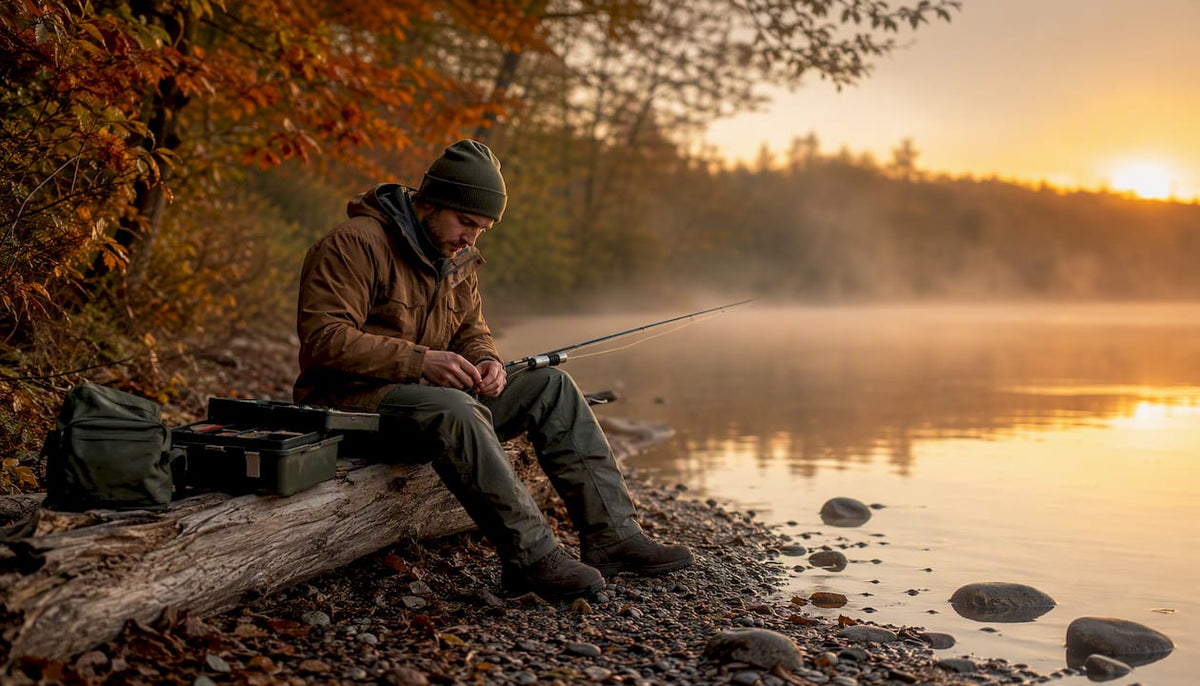
Your core earth tone color palette: Olive #556B2F · Rust #8B4513 · Sand #C2B280 · Cream #F5F0E8 · Taupe #8B7355 · Moss #4A5240 · Clay #A0522D
The one styling rule that makes this work: anchor with a dark earth tone, break it with a lighter neutral, and add texture through your layers. Here’s what that looks like on your body at 5 AM:
| Garment | Color | Hex |
|---|---|---|
| Base tee | Cream or sand |
#F5F0E8 / #C2B280
|
| Mid layer (flannel or fleece) | Olive or moss |
#556B2F / #4A5240
|
| Outer (canvas or waxed jacket) | Chocolate | #3B2314 |
That’s the whole system. Everything below helps you build it out, shop it smarter, and keep it looking good after a season on the water.
Table of Contents
- What counts as an earth tone for apparel shoppers?
- Why earth tones work so well for anglers and pre-dawn use
- How do you build a durable earth-tone outdoor wardrobe?
- Six curated palettes with hex codes and outfit templates
- What fabrics and finishes hold earth tones best?
- How to shop for earth-tone outdoor apparel without guessing
- Key Takeaways
- Why most people overthink earth tones
- Firstriseoutfitters earth-tone fishing shirts, ready to wear
What counts as an earth tone for apparel shoppers?
Earth tones are colors pulled directly from the natural world: soil, stone, bark, clay, and foliage. In clothing, that means any shade that reads as muted, warm, and low-saturation. Browns, tans, olives, rusts, taupes, grays, and nature-derived tints all qualify.
What makes a color an earth tone in apparel is less about the hue and more about the saturation. A green can be an earth tone (olive, sage, moss) or not (neon lime). The test: does it look like something you’d find on a riverbank? If yes, it counts.
Common earth-tone names you’ll see on product pages:
- Olive, sage, moss, forest
- Camel, sand, tan, khaki, ecru
- Rust, terracotta, clay, burnt orange
- Taupe, mushroom, stone, pebble
- Cream, ivory, linen, oatmeal
- Chocolate, espresso, bark, walnut
Shopper cues to look for in product descriptions:
- “Garment-dyed” or “washed” (signals a lived-in, muted finish)
- “Low-saturation” or “muted” in color notes
- Hex codes in the warm-neutral or desaturated-green range
- Words like “vintage,” “faded,” or “pigment-dyed”
Why earth tones work so well for anglers and pre-dawn use
The short answer: these colors belong in the environment you’re fishing. Olive, sage, camel, rust, sand, and cream are the shades you’d see along any cold-water stream at dawn. Wearing them means you blend in rather than stand out, which matters when you’re 10 feet from a feeding trout.
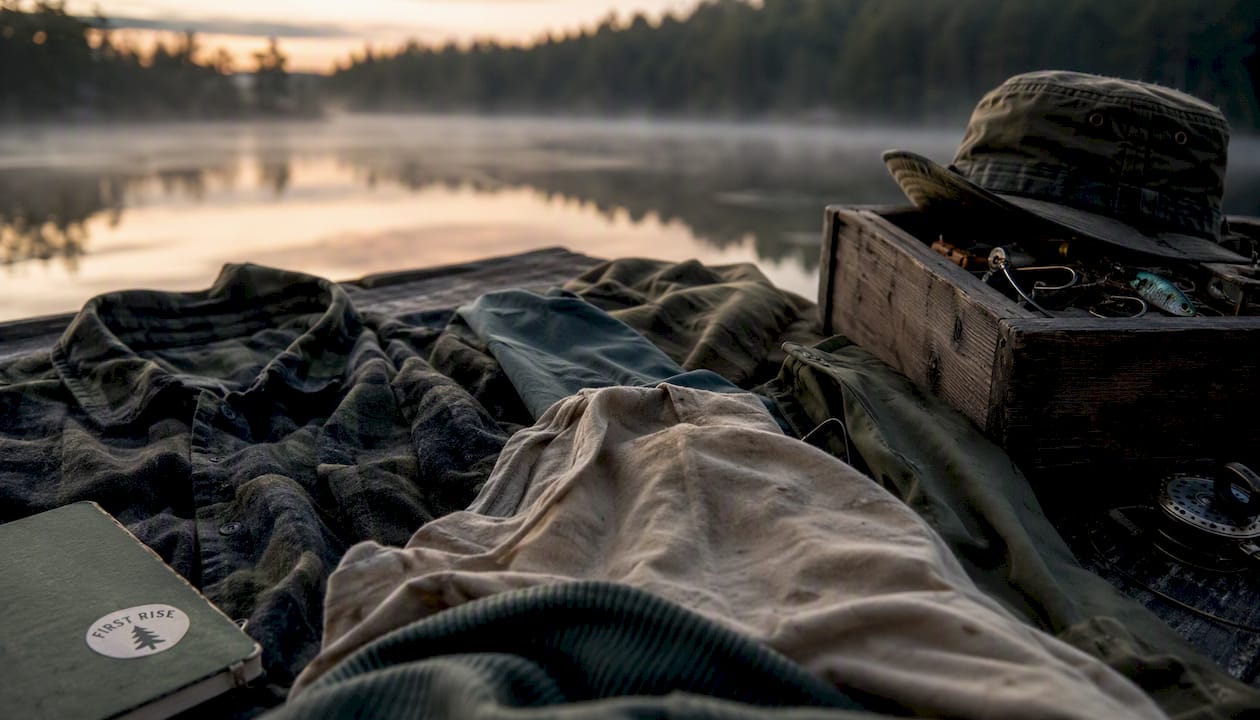
There are practical benefits beyond camouflage, too. Muted tones hide water stains, mud, and fish slime far better than white or bright colors. They photograph well in natural light, which is useful if you’re documenting a catch. And under the flat, gray light of early morning, earth tones read as intentional and put-together in a way that brighter colors simply don’t.
The behavioral benefit is real but underrated: a coordinated earth-tone wardrobe means every piece matches every other piece. When your alarm goes off at 4:30 AM, you’re not making decisions. You grab what’s there and it works.
Pro Tip: For low-light or foggy conditions, add one small high-visibility element, like a reflective strip on your pack or a blaze-orange patch on your hat, to stay safe without breaking the palette.
How do you build a durable earth-tone outdoor wardrobe?
Think of it as four steps, not a full closet overhaul.
-
Pick a dark anchor. Deep olive (
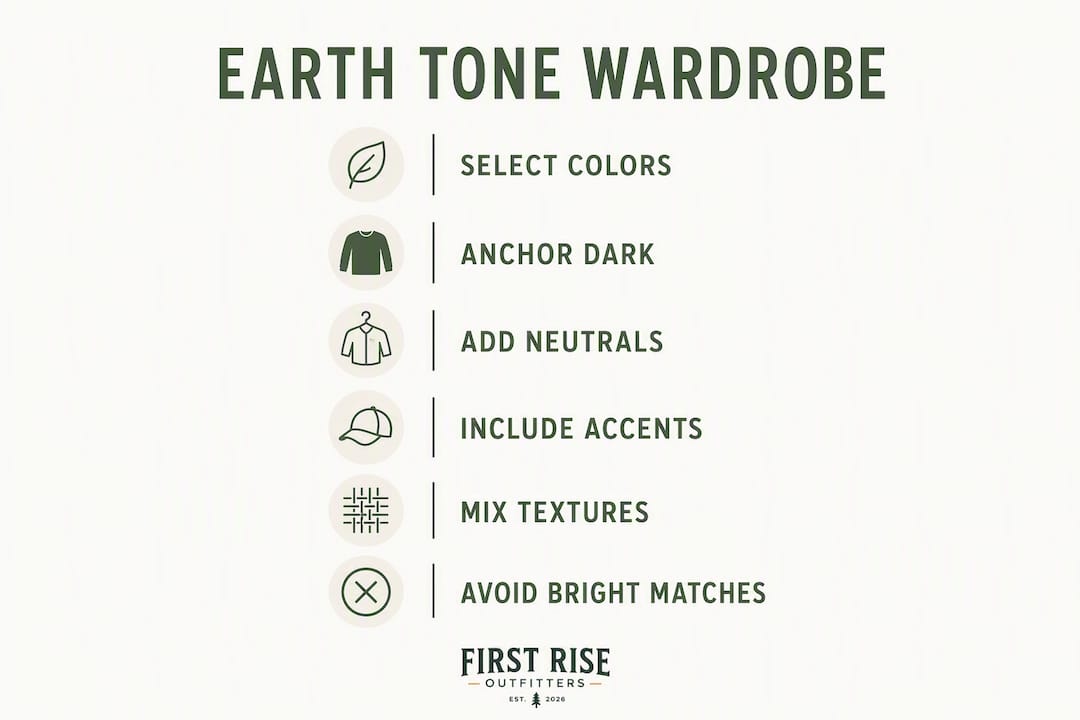
#3B4A2F), chocolate brown (#3B2314), or charcoal (#36454F) grounds every outfit (the same anchor codes as in the palettes and outfit templates below). This is usually your outer layer or your heaviest mid layer. - Choose 2–3 lighter neutrals for bases. Sand, cream, and ecru are your tees and base layers. They lighten the outfit and prevent the anchor from feeling heavy.
- Add 2 accent earth tones for warmth. Rust and terracotta bring warmth; moss and sage bring coolness. Pairing a warm accent with a cool anchor creates temperature contrast, which is what keeps an all-earth-tone outfit from looking flat. Styling formulas like olive + ecru or clay + stone use exactly this logic.
- Plan your textures. A ribbed knit tee under a brushed canvas shirt under a waxed jacket gives you three different surface finishes. That layered texture is what makes low-saturation colors look rich rather than dull.
A minimalist capsule approach suggests 8–12 complementary colors total: 4–5 neutral bases plus 3–4 earthy accents. For anglers, that’s plenty. You don’t need more than that to cover every condition from a July morning wade to a November tailgate.
Pro Tip: Never place two earth tones of the same brightness next to each other. Sand on cream looks washed out. Sand on deep olive looks intentional. Value contrast is the whole game.
Six curated palettes with hex codes and outfit templates
These six palettes are tuned for specific conditions you’ll actually encounter on the water or on the trail.
| Palette | Anchor | Base 1 | Base 2 | Accent 1 | Accent 2 | Best for |
|---|---|---|---|---|---|---|
| Riverbank |
#3B4A2F deep olive |
#C2B280 sand |
#F5F0E8 cream |
#8B4513 rust |
Taupe | Shoreline fishing, spring/summer |
| Dawn Patrol |
#36454F charcoal |
Warm linen |
#F5F0E8 cream |
Sage | Dark brown | Foggy mornings, fall/winter |
| Clay Camp |
#A0522D clay |
#C2B280 sand |
#E8DCC8 ecru |
#4A5240 moss |
#8B7355 taupe |
Campfire evenings, fall |
| Moss & Log |
#4A5240 moss |
Warm linen |
#C2B280 sand |
#8B4513 rust |
Taupe | Dense cover, spring |
| Sandbar |
#8B7355 taupe |
#F5F0E8 cream |
#E8DCC8 ecru |
Camel | Sage | Open water, summer |
| Ember Creek |
#3B2314 chocolate |
#C2B280 sand |
#F5F0E8 cream |
#A0522D clay |
#8B4513 rust |
Cold mornings, late fall/winter |
Outfit templates by palette:
- Riverbank (spring/summer): Cream tee (base) + sand long-sleeve (mid) + deep olive canvas shirt (outer) + taupe ball cap. Lightweight cotton throughout.
- Dawn Patrol (fall/winter): Warm linen tee + sage fleece mid layer + charcoal waxed jacket + dark brown wool beanie. Add a rust buff for neck warmth.
- Ember Creek (late fall/winter): Cream tee + clay flannel + chocolate canvas outer + rust knit hat. Heaviest layering of the six.
For national park and river-themed shirts that map directly to these palettes, the Riverbank and Ember Creek combinations work especially well with vintage-style trout graphics.
What fabrics and finishes hold earth tones best?
Garment-dyed cotton is the gold standard for muted earth tones. The dye process happens after the garment is sewn, which gives colors a slightly uneven, lived-in quality that looks intentional rather than flat. Comfort Colors blanks are the most recognized name in garment-dyed tees for exactly this reason. Bella+Canvas and Gildan blanks offer different fits and weights, with Bella+Canvas running softer and more fitted, and Gildan providing a heavier, more durable option.
For outer layers, brushed canvas and waxed cotton hold earth tones well and develop a natural patina over time. Corduroy adds texture that makes muted colors read as richer. Technical blends (cotton-poly) are fine for base layers but can make colors look slightly synthetic, which works against the natural aesthetic.
Care tips to preserve muted dye vibrancy:
- Wash in cold water, inside out, on a gentle cycle.
- Skip harsh detergents; a mild, dye-safe formula protects garment-dyed finishes.
- Air dry when possible. High heat fades garment-dyed cotton faster than anything else.
- Re-proof waxed finishes once a season with a dedicated wax bar.
- Store away from direct sunlight, which bleaches low-saturation colors unevenly.
Mixing textures across layers, such as a ribbed knit tee under a brushed canvas overshirt, adds visual depth without any bright color. That’s the move when you want an earth-tone outfit to look rich rather than muddy.
How to shop for earth-tone outdoor apparel without guessing
The biggest mistake shoppers make is trusting a color name without checking the hex or the dye method. “Olive” on one brand is a bright army green; on another it’s a muted, almost-brown sage. Here’s a checklist that cuts through that.
- Confirm the exact color name and hex code before buying.
- Check whether the product is garment-dyed, yarn-dyed, or screen-printed on a dyed blank.
- Verify fabric weight and composition (heavier cotton holds muted dyes better).
- Look for Comfort Colors, Bella+Canvas, or Gildan blank callouts in the product description.
- Read the wash instructions before checkout, not after.
- Check the return policy, especially for online orders where screen color can vary.
Fit and layering tips for anglers:
- Size up one for mid and outer layers to allow casting movement.
- Choose long-sleeve base layers for sun protection and warmth during pre-dawn hours.
- Avoid overly fitted outer layers; you need room for a fleece underneath.
For guidance on fit specific to women anglers, fishing clothes for women covers layering and sleeve-length considerations in detail.
Pro Tip: Product photos shot in studio lighting often make earth tones look brighter than they are outdoors. Look for lifestyle photos taken in natural light for the most accurate color read.
For pre-dawn temperatures, plan for at least three layers: a lightweight base, an insulating mid, and a wind-resistant outer. The Ember Creek and Dawn Patrol palettes are built for exactly that stack.
Key Takeaways
A coordinated earth tone color palette built on one dark anchor, two lighter neutrals, and two accent tones gives you a wardrobe where every piece works together before the sun is even up.
| Point | Details |
|---|---|
| Anchor + contrast rule | Pair a deep earth tone (olive, chocolate) with a lighter neutral (sand, cream) to avoid a washed-out look. |
| Texture over brightness | Mix ribbed knit, brushed canvas, and waxed finishes to add depth without introducing bright colors. |
| Care for muted dyes | Cold wash, gentle detergent, and air drying preserve garment-dyed color longer than any other method. |
| Palette by condition | Use Dawn Patrol (charcoal + sage) for foggy mornings; Riverbank (deep olive + rust) for shoreline fishing. |
| Firstriseoutfitters | Garment-dyed tees on Comfort Colors, Bella+Canvas, and Gildan blanks in muted, river-inspired tones built for early-morning anglers. |
Why most people overthink earth tones
Here’s the thing about earth-tone dressing that rarely gets said plainly: you can’t really get it wrong if you follow the value-contrast rule. The reason people end up with outfits that look muddy or flat isn’t that they chose the wrong colors. It’s that they put two shades of the same brightness next to each other and expected them to do something interesting.
The outdoor apparel world has a habit of overcomplicating this. You don’t need a 40-piece capsule or a color-theory degree. You need one dark anchor, one light base, and a texture that makes the combination feel intentional. That’s it. The palettes in this article are built around that principle, and they’re designed to work specifically in the light conditions anglers actually deal with: flat gray dawn, harsh midday sun on open water, and the warm amber of a late-fall afternoon on a tailgate.
What I’d push back on is the idea that earth tones are a trend. They’re not. They’re what the natural world actually looks like, and they’ve been the default palette for people who spend time outdoors long before any fashion cycle picked them up. The mid-2020s interest in muted, nature-inspired color is just the rest of the world catching up to what anglers and hikers already knew.
Firstriseoutfitters earth-tone fishing shirts, ready to wear
If you’ve built your palette and you’re ready to fill the base-layer slot with something worth wearing, Firstriseoutfitters makes garment-dyed tees in muted, river-inspired tones that map directly to the palettes above. Every shirt features hand-designed trout artwork, printed on Comfort Colors, Bella+Canvas, or Gildan blanks depending on the style.
A few specific options worth looking at:
- Brook Trout Fishing T-Shirt on a Comfort Colors blank, fits the Riverbank and Moss & Log palettes.
- Rocky Mountain Fishing Shirt in vintage trout colorways, built for the Ember Creek palette.
- Cutthroat Trout Anatomy T-Shirt on a Bella+Canvas 3001 blank, a softer, more fitted option for layering.
- Yellowstone River Co. Fishing T-Shirt in park-inspired muted tones, pairs with the Dawn Patrol palette.
All products ship with clear sizing notes and a return policy. Browse the full Trout Heritage collection to see the complete range of muted tones and blank options available.
Recommended
- Early Morning Fishing Stories and Dawn Apparel Picks – First Rise Outfitters
- How to Choose a Fishing Shirt for Early Risers – First Rise Outfitters
- Best Alternatives to Howler Bros for Anglers and Hikers – First Rise Outfitters
- Top 6 Best Fishing Apparel Brands Alternatives 2026 – First Rise Outfitters