Best Outdoor Graphic Tees for Hikers: Durable Picks
By Bobby Harris — Navy FMF Corpsman (2002–2010), founder of First Rise Outfitters
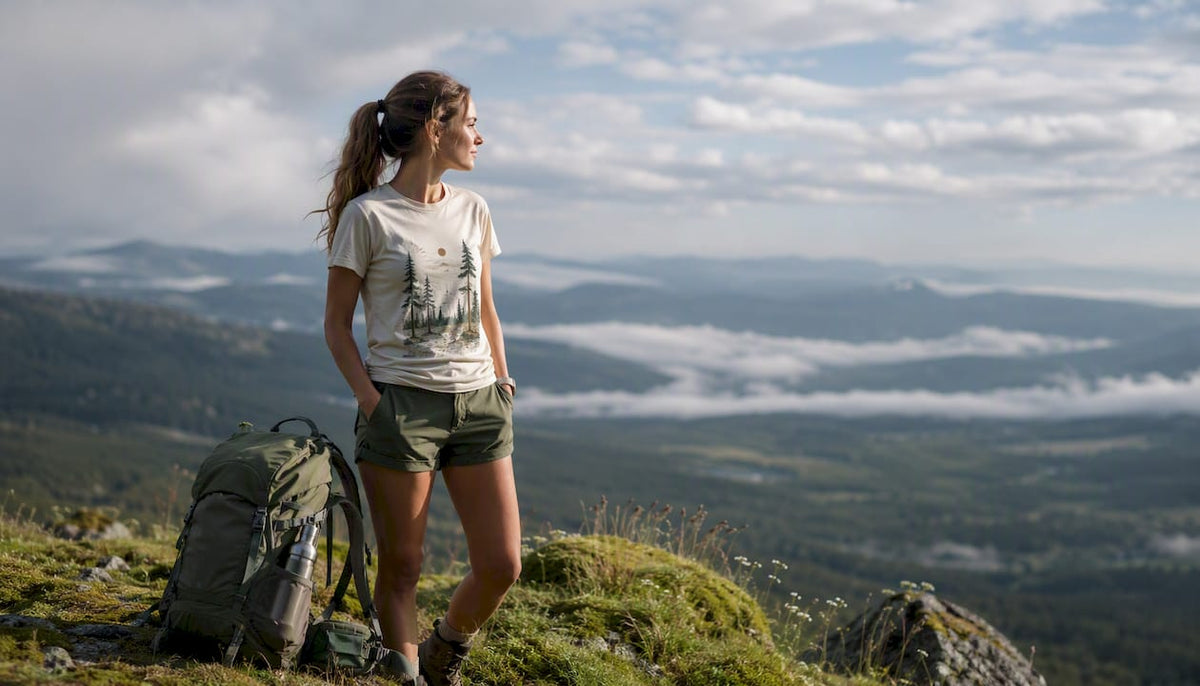
Firstriseoutfitters is the top pick for outdoor graphic tees because it combines garment-dyed Comfort Colors blanks, durable prints, and hand-designed trout and park artwork that actually means something to hikers and anglers. If you want a tee that looks at home on a tailgate at 5 AM or a mountain trail at noon, this is where to start. For performance-leaning options, brands that offer UPF 50+ and moisture-wicking blends are worth a look. For park-specific souvenirs, small direct-to-consumer shops with place-based designs fill that gap well.
Three reasons Firstriseoutfitters stands out:
- Garment-dyed Comfort Colors blanks that hold color wash after wash
- Durable prints in muted, nature-inspired tones built for real outdoor use
- Species- and location-specific artwork with genuine conservation messaging
Pro Tip: When shopping for outdoor graphic tees, check the blank first. A garment-dyed Comfort Colors or Bella+Canvas tee will outlast a generic blank by years, and the print will look better longer.
Table of Contents
- What should you look for in the best outdoor graphic tees?
- Which fabrics and print methods actually hold up outdoors?
- How does fit affect your comfort and layering on the trail?
- How to wash graphic tees so the print lasts for years
- What design themes resonate with hikers and outdoor enthusiasts?
- Why Firstriseoutfitters is a strong pick for outdoor graphic tees
- Where can you buy outdoor graphic tees, and what should you pay?
- Key Takeaways
- Why the shirt on your back tells a story worth getting right
- Firstriseoutfitters tees built for early risers and trail days
- Useful sources
What should you look for in the best outdoor graphic tees?
Not every graphic tee survives the trail. Here is a quick checklist to run through before you buy.
Start with the blank. The blank is the shirt itself, before any print is applied. Three names worth knowing:
- Comfort Colors (garment-dyed, mid-weight, soft hand feel, excellent color retention)
- Bella+Canvas (lightweight, ring-spun cotton, clean print surface, great for detailed artwork)
- Gildan (budget-friendly, widely available, consistent sizing, heavier weight options available)
Garment-dyed blanks like Comfort Colors go through a dye process after construction, which gives them a lived-in, faded look from day one and makes them more resistant to further fading. That matters a lot when you are washing trail dust out every weekend.
Next, ask about the print method. Screen print and discharge inks hold up better over time than direct-to-garment (DTG) on most cotton blanks. Water-based inks feel softer against skin, which you will appreciate on a long day hike.
Performance features to weigh:
- Moisture-wicking or quick-dry fabric if you run warm on the trail
- UPF rating (UPF 50+ blocks over 98% of UV rays) for exposed ridgeline hikes
- Odor-control treatments for multi-day trips
- Fabric weight: mid-weight (around 6 oz) balances durability and breathability for active use
Sizing and fit: Think about whether you will layer the tee under a shell or fleece. A slightly looser cut gives you more freedom of movement and makes layering easier without bunching.
Sustainability prompts to ask at checkout:
- Is the blank made from organic or recycled fibers?
- Does the brand use water-based or low-impact inks?
- Is there a conservation or give-back component to the purchase?
Which fabrics and print methods actually hold up outdoors?
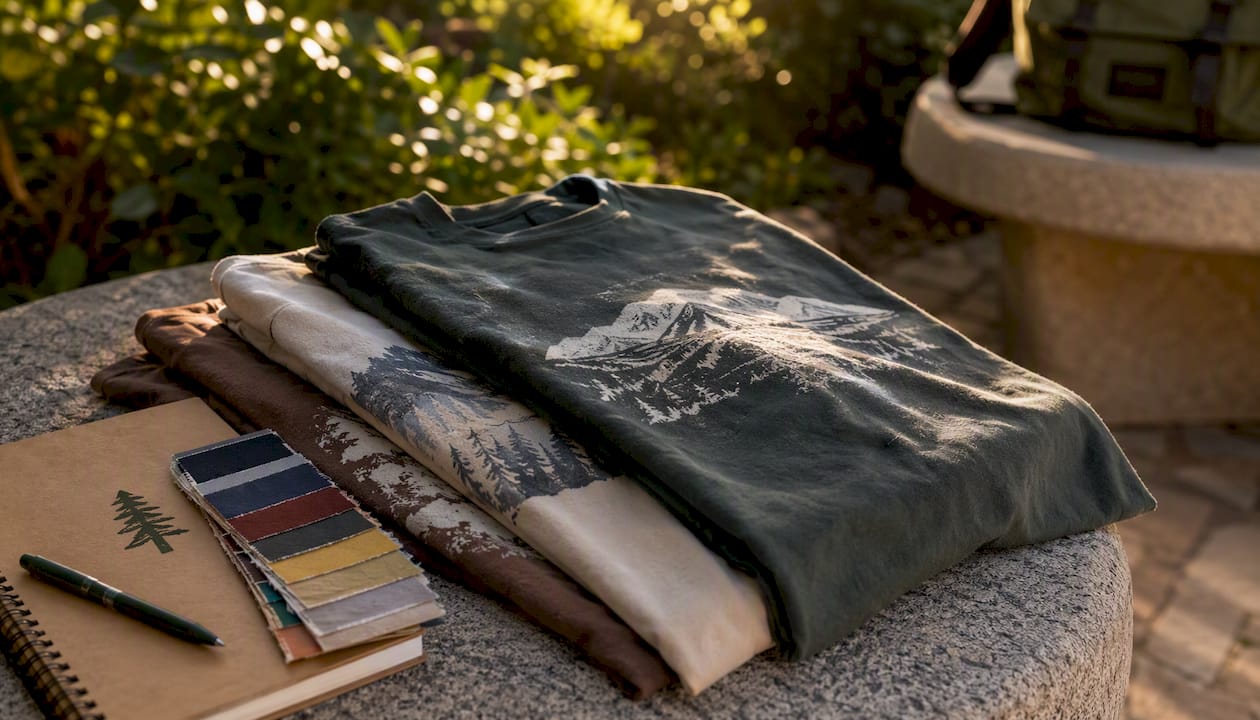
Fabric and print method are the two decisions that determine whether your tee looks great after fifty washes or falls apart after ten.
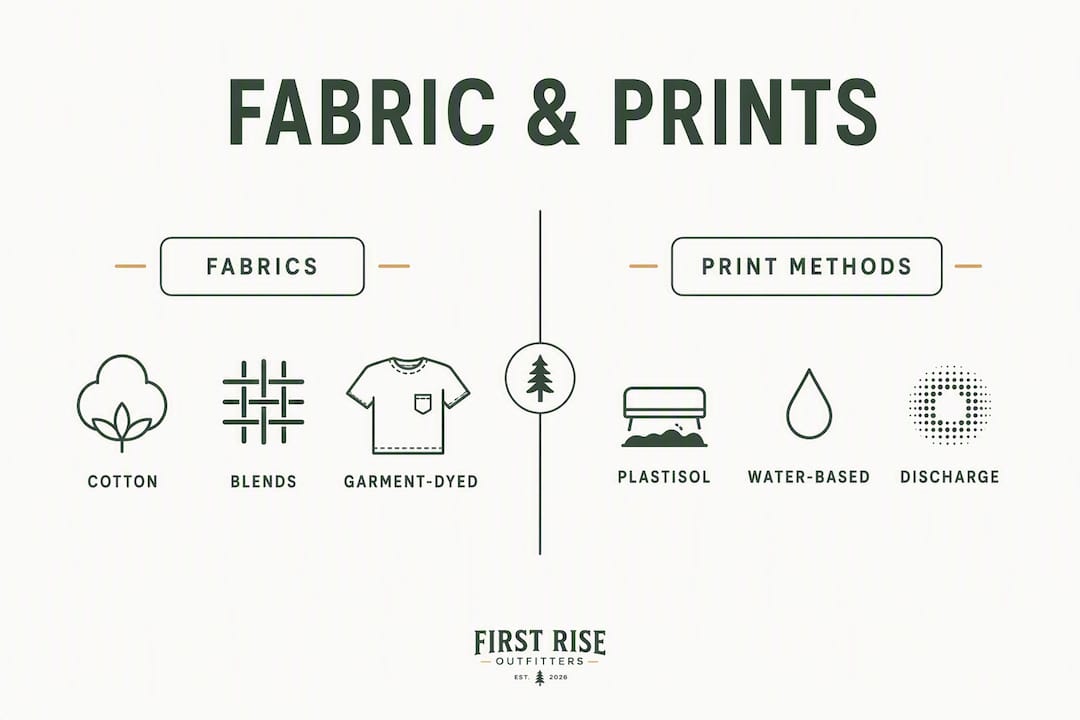
Cotton, blends, and garment-dyed blanks
Pure 100% cotton is breathable and comfortable, but it absorbs moisture and dries slowly. For casual trail wear and campfire nights, that tradeoff is fine. For active hiking in heat, a cotton-polyester blend (typically 50/50 or 60/40) dries faster and resists odor better. Recycled polyester blends are increasingly common and carry a lower environmental footprint.
Mid-weight fabrics (roughly 5.5–6.5 oz per square yard) are the sweet spot for outdoor use. They are durable enough to handle repeated abrasion from pack straps and backpack hip belts, yet breathable enough for warm-weather hiking. Lightweight knits feel great in summer but can pill or thin out faster under heavy use.
Garment-dyed blanks, like the Comfort Colors 1717, stand apart from piece-dyed alternatives. The dye process happens after the shirt is sewn, which means the color penetrates every fiber more deeply. The result is a richer, more complex tone that fades gracefully rather than washing out unevenly. Firstriseoutfitters builds its core line on these blanks, and you can see the difference in person on the Glacier National Park Shirt, which uses the Comfort Colors 1717 blank.
How print methods compare
| Print Method | Durability | Hand/Feel | Best For |
|---|---|---|---|
| Screen print (plastisol) | High | Slightly raised, firm | Bold, simple designs; long wash life |
| Discharge / water-based | High | Soft, breathable | Detailed art; great for active wear |
| DTG (direct-to-garment) | Moderate | Very soft | Complex full-color artwork; shorter run sizes |
| Heat transfer | Low–Moderate | Stiff if thick | Custom one-offs; not ideal for trail use |
Screen printing with water-based or discharge inks is the gold standard for outdoor tees. Discharge inks actually remove the dye from the fabric and replace it with pigment, so the print sits flush with the shirt rather than sitting on top. That means no cracking, no peeling, and no stiff patch on your chest after a sweaty climb.
DTG printing has improved significantly, but it still tends to fade faster on cotton than screen printing does, especially with repeated hot-water washing. If a brand uses DTG, cold-water washing and line drying become even more important.
Quick tips for reading product descriptions:
- “Water-based inks” and “discharge print” are good signs for durability and comfort
- “Soft hand” or “soft feel” usually indicates water-based or discharge process
- If the listing says nothing about print method, ask before buying
How does fit affect your comfort and layering on the trail?
A tee that fits well at the store can feel completely different after a six-mile climb with a pack on. Fit is worth thinking through before you buy.
Regular fit is the most versatile. It gives you room to move without excess fabric bunching under a hip belt. Most outdoor graphic tees from quality brands default to a regular fit, and it works for both trail and casual wear.
Slim fit looks sharp off-trail but can restrict shoulder movement when you are reaching overhead or scrambling. If you hike with trekking poles or do any technical terrain, slim fit is a tradeoff.
Oversized fit is trending in outdoor fashion right now, and it works well for campfire hangs and travel days. On a hot, active hike, though, extra fabric traps heat and moisture.
Fit rules of thumb for hikers:
- You should be able to raise both arms overhead without the hem pulling up past your waistband
- Two fingers of slack at the chest is a good baseline for layering clearance
- Garment-dyed blanks like Comfort Colors tend to run slightly large and will shrink a little after the first wash
- If you plan to layer under a softshell or fleece, size up one
Pro Tip: Garment-dyed blanks often shrink 3–5% in the first wash. If you are between sizes and plan to layer, go one size up. Wash cold and line dry to minimize further shrinkage.
For more guidance on building a complete outdoor kit around your tee, the stylish hiking clothes guide from Firstriseoutfitters covers layering from base to shell.
How to wash graphic tees so the print lasts for years
Prints fail for one reason more than any other: heat. Hot water, hot dryers, and direct ironing over a print will break down the ink bond faster than anything else. The good news is that a simple care routine keeps most quality prints looking sharp for years.
Step-by-step care:
- Turn the shirt inside out before washing. This protects the print from direct friction against other garments.
- Wash in cold water on a gentle cycle.
- Use a mild, dye-free detergent. Avoid anything with bleach or optical brighteners.
- Skip enzymatic stain removers on the print area. Enzymes target proteins and can break down certain ink binders.
- Tumble dry on low heat, or line dry. Line drying is always the safer option for garment-dyed fabrics.
- If you iron, turn the shirt inside out and use a low setting. Never iron directly over a print.
Quick do/don’ts:
- ✓ Cold wash, gentle cycle
- ✓ Mild detergent, no bleach
- ✓ Low heat or air dry
- ✓ Store folded, not on a hanger (hanging stretches the collar over time)
- ✗ Hot water wash
- ✗ High-heat dryer
- ✗ Ironing directly over the print
- ✗ Fabric softener sheets (they coat fibers and can dull garment-dyed colors)
Pro Tip: If a print starts to crack at the edges, a thin layer of fabric glue applied with a toothpick can seal small separations before they spread. It buys you another season out of a shirt you love.
What design themes resonate with hikers and outdoor enthusiasts?
The best outdoor tees do not just look good. They tell a story about where you have been or what you care about. That is why design choice matters as much as fabric.
Popular motifs in outdoor graphic tees:
- Topographic maps and trail routes: Great for commemorating a specific hike or range. Works well as a souvenir piece.
- National park artwork: Vintage-style park illustrations carry a nostalgic, collectible feel. Firstriseoutfitters publishes a curated list of national park t-shirt options if you want a starting point.
- Species illustrations (trout, elk, bear, birds): These designs appeal to anglers, hunters, and wildlife enthusiasts. The more specific the species, the more personal the connection.
- Minimalist trail icons and mountain silhouettes: Clean, versatile designs that work on and off trail without looking costume-y.
- Vintage river and fishing artwork: Muted tones, hand-drawn style, and location-specific details give these a worn-in authenticity that mass-market prints rarely achieve.
Color and palette guidance: Muted, earthy tones (olive, slate, faded rust, river blue) age better than neon or bright palettes. They also photograph well in natural light, which matters if you document your trips. Bright colors can feel out of place on a trail and fade unevenly on garment-dyed blanks.
When to choose which design:
- Day hike or summit: minimalist icon or mountain silhouette, regular fit, mid-weight cotton
- Campfire or base camp: species illustration or vintage river art, relaxed fit, garment-dyed blank
- Travel or gift: national park or location-specific design, something tied to a place you have been or want to go
Original artwork matters. A hand-designed illustration carries more character than a stock graphic, and it supports the artist or brand behind it. Brands that design in-house and print with intention produce tees that feel different from mass-market options, and that difference shows up in how the shirt wears over time.
Why Firstriseoutfitters is a strong pick for outdoor graphic tees
Firstriseoutfitters builds its tees around a specific idea: the best days start early, and the shirt you wear should reflect that. The core line uses garment-dyed Comfort Colors blanks in muted, river-inspired tones, with hand-designed artwork of brook, brown, rainbow, and cutthroat trout alongside National Park and river-themed graphics.
A few product examples worth knowing:
- Rocky Mountain Fishing Shirt: Garment-dyed Comfort Colors blank, vintage trout artwork, Colorado fly fishing theme. A strong pick for anglers who hike to their water.
- Wild Country Species Tee: Wildlife heritage artwork, species-specific design, works as everyday wear or a trail shirt.
- Glacier National Park Shirt: Comfort Colors 1717 blank, mountain goat illustration, Montana hiking theme. One of the cleaner park-themed tees available.
- Cutthroat Trout Anatomy Tee: Printed on a Bella+Canvas 3001 blank, which runs slightly lighter and softer than the Comfort Colors option. Good for warmer climates or those who prefer a trimmer fit.
Why these tees work for hikers and anglers:
- Garment-dyed blanks hold color better than piece-dyed alternatives
- Hand-designed artwork gives each shirt a specific identity, not a generic outdoor logo
- Conservation messaging ties the purchase to something beyond fashion
- Muted tones photograph well and age gracefully
The Trout Heritage collection is the best starting point if you want a curated set of species-focused tees in one place.
Where can you buy outdoor graphic tees, and what should you pay?
Buying channel matters almost as much as the shirt itself. Here is how the main options break down.
Direct-to-consumer brand shops (like Firstriseoutfitters) give you the most transparency. You can see the blank, the print method, and the design story. Returns are usually straightforward, and you are buying directly from the people who made the shirt.
Independent and small-maker shops often produce limited runs with original artwork. Price points tend to run in the range typical for premium tees. The tradeoff is that sizing and quality can vary more than with established brands.
National park stores and visitor center shops carry location-specific designs that make excellent souvenirs. Quality varies widely, from garment-dyed blanks with original art to basic screen prints on generic blanks.
Third-party marketplaces offer the widest selection and the lowest prices, but print method and blank quality are rarely disclosed. A $15 tee from a marketplace is almost certainly a DTG print on a basic blank, which means it will fade faster.
| Price Range | What You Typically Get |
|---|---|
| Under $25 | Basic blank, likely DTG print, limited design detail |
| $25–$32 | Mid-tier blank (Gildan, generic cotton), screen print, decent durability |
| $32–$40 | Premium blank (Comfort Colors, Bella+Canvas), quality print method, original artwork |
| $50+ | Limited run, specialty blank, hand-finished details, or licensed park art |
Checklist for choosing where to buy:
- Does the listing disclose the blank brand and print method?
- Is there a clear return or exchange policy?
- Are customer reviews specific about fit, shrinkage, and print quality?
- Does the brand make sustainability or conservation claims it can back up?
If you are traveling through a park and want a location-specific tee, buy it there. Those designs are often unavailable anywhere else. For everyday outdoor wear and gift buying, a direct-to-consumer shop with disclosed blank and print information is the better long-term investment.
Key Takeaways
The best outdoor graphic tee combines a quality blank, a durable print method, and artwork that means something to you. Firstriseoutfitters delivers all three with garment-dyed Comfort Colors blanks, hand-designed trout and park artwork, and conservation-minded messaging built for hikers and anglers.
| Point | Details |
|---|---|
| Blank quality first | Look for Comfort Colors, Bella+Canvas, or Gildan blanks — the blank determines how the shirt ages. |
| Print method matters | Screen print and discharge inks outlast DTG on cotton; water-based inks feel best for active wear. |
| Fit for layering | Size up one if you plan to layer; garment-dyed blanks shrink slightly after the first wash. |
| Care extends print life | Wash inside out in cold water, dry on low heat or line dry, and never iron directly over the print. |
| Firstriseoutfitters | Recommended for hikers and anglers: garment-dyed Comfort Colors blanks, hand-designed species and park artwork, conservation messaging. |
Why the shirt on your back tells a story worth getting right
There is a version of outdoor apparel that is purely functional, and there is a version that carries meaning. The best outdoor graphic tees sit at the intersection of both. They hold up on the trail, but they also remind you of a specific river, a specific summit, or a specific morning when everything went right.
What gets underestimated is how much the blank and the print method contribute to that story. A tee that fades unevenly or cracks after a season does not hold the memory the same way. The shirt you wore on your first backcountry trip should still look like itself five years later. That requires a garment-dyed blank that ages with intention and a print method that does not treat the design as disposable.
Conservation messaging is not just marketing copy when it comes from a brand that actually designs around specific species and places. It signals that someone thought carefully about what the shirt represents, not just how it looks on a product page. That distinction matters to hikers and anglers who spend real time in the places these shirts depict.
Firstriseoutfitters tees built for early risers and trail days
If you have been looking for outdoor graphic t-shirts that hold up on the water and look right off it, Firstriseoutfitters is the direct answer. These are not mass-market shirts with a mountain logo slapped on. Every tee is built on a quality blank, printed with artwork designed specifically for anglers, hikers, and people who take the first light seriously.
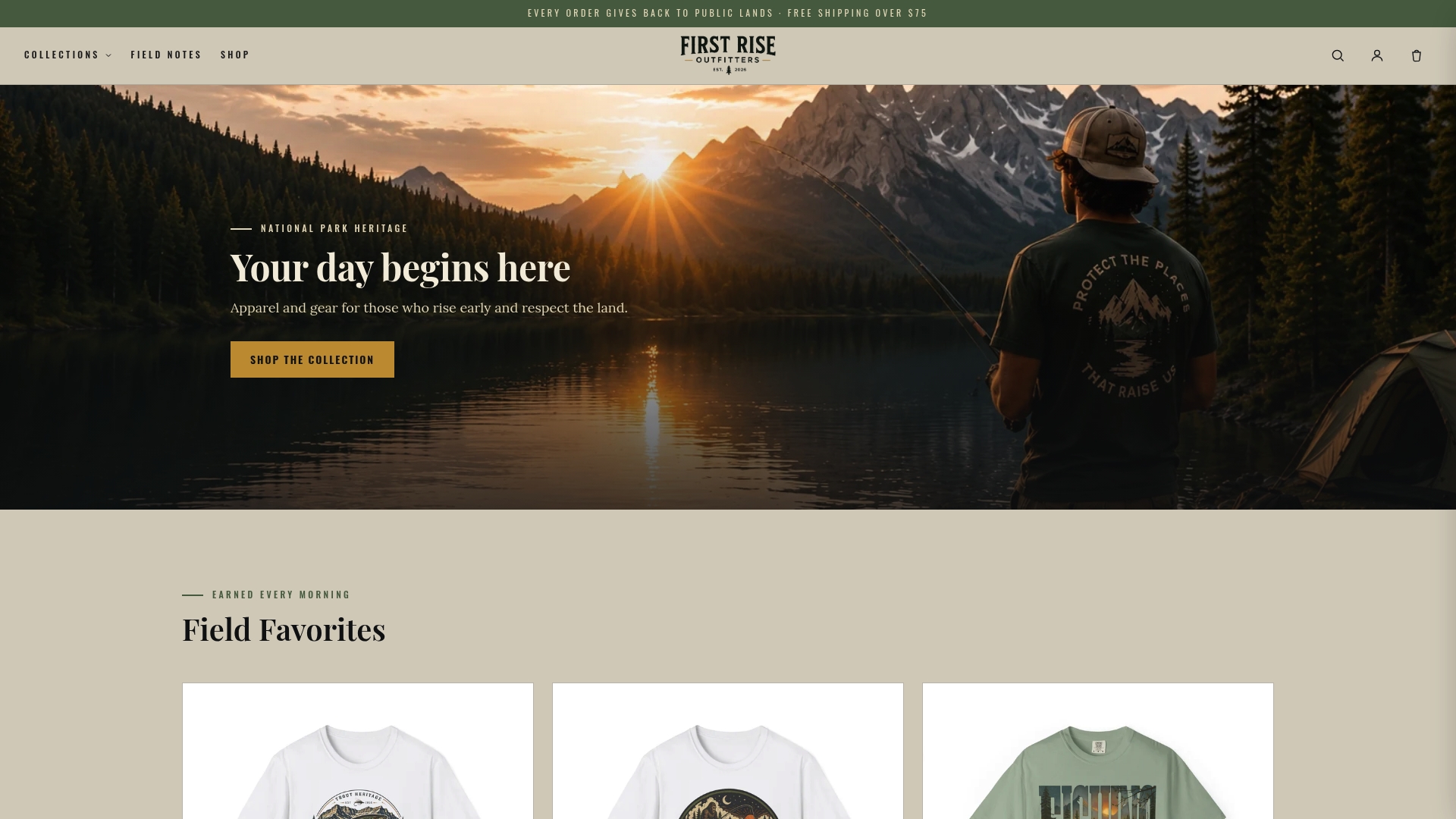
A few strong starting points from the current lineup:
- Glacier National Park Shirt — Comfort Colors 1717 blank, mountain goat artwork, Montana hiking theme
- Rocky Mountain Fishing Shirt — Garment-dyed blank, vintage Colorado trout art, great for anglers and hikers alike
- Yellowstone River Co. Fishing T-Shirt — Park-themed fishing design, vintage trout artwork, Yellowstone-specific
- Cutthroat Trout Anatomy Tee — Bella+Canvas 3001 blank, detailed species illustration, lighter-weight option
- Funny Fisherman Shirt — Casual angler tee, great as a gift for the fly fishing crowd
Browse the full Trout Heritage collection for species-focused designs, or check the sale page for current promotions.
Useful sources
The following links were used as references for product details, editorial content, and market context in this article.
Firstriseoutfitters product and editorial pages:
- Rocky Mountain Fishing Shirt — Firstriseoutfitters (product page)
- Wild Country Species Tee — Firstriseoutfitters (product page)
- Glacier National Park Shirt — Firstriseoutfitters (product page)
- Top 6 National Park T-Shirt Options 2026 — Firstriseoutfitters (editorial blog post)
- Trout Heritage Collection — Firstriseoutfitters (collection page)
- Stylish Hiking Clothes — Firstriseoutfitters (editorial blog post)
External market references:
- Outdoor Graphic Tees — Timpanogos Hiking Co. (small-brand direct shop, price reference)